Everyone says they understand their customer. Ask the system what it actually holds and it’s thin: a gender guess, a rough location, a few categories you’ve clicked, maybe a couple of past orders. That file is what “we understand our customer” usually means.
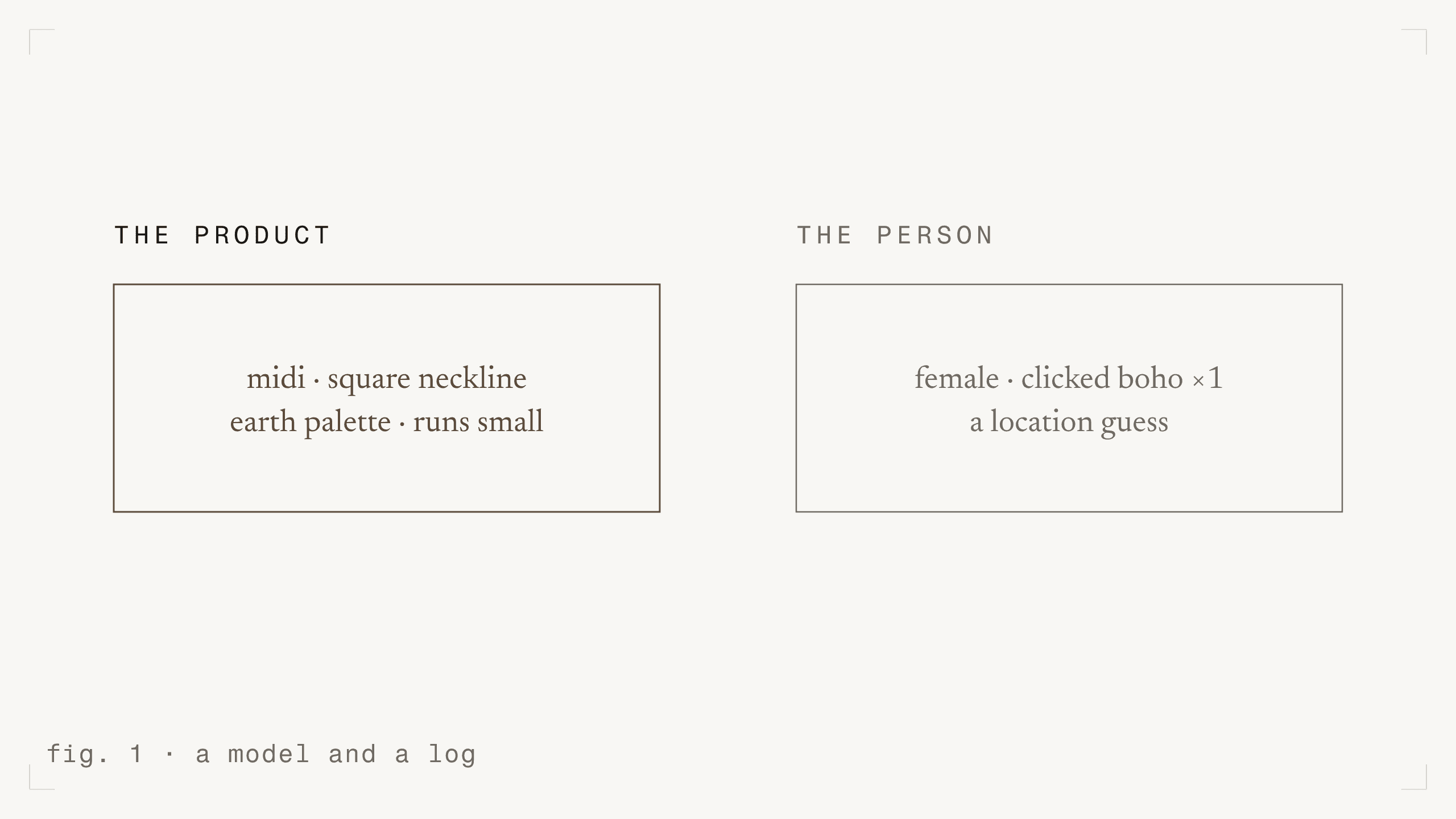
Do the enrichment on the catalog side, though, and the products come out structured. A dress becomes a midi length with a square neckline, a floral print in an earth-toned palette. It has a material, a cut that runs small, a set of occasions it suits: one shopper would wear it to the office, another to a wedding. Someone did the work to turn it into a structure you can reason over.
So even in a system that did the catalog work, the two sides are written in different languages: the product is a model, and the person is a log.
![fig. 1 - a model and a log [dark]](https://framerusercontent.com/images/z7Lms8F1EzydsuVYqlaiGWCzbHM.png)
![fig. 1 - a model and a log [m]](https://framerusercontent.com/images/wIgjy4ENWCkl81JedAi1HZ2Gwtw.png)
![fig. 1 - a model and a log [m] [dark]](https://framerusercontent.com/images/QY9tuZC7YN4fC0wA3wR03shk.png)
That gap is the whole problem, because personalization is one move: take what someone wants and connect it to the option that fits. You can only connect two sides described in the same terms. When the product is a set of attributes (style, occasion, fit, palette, price behavior) and the person is “female, clicked boho once,” there’s nothing to line up. The attributes on one side have no counterpart on the other.
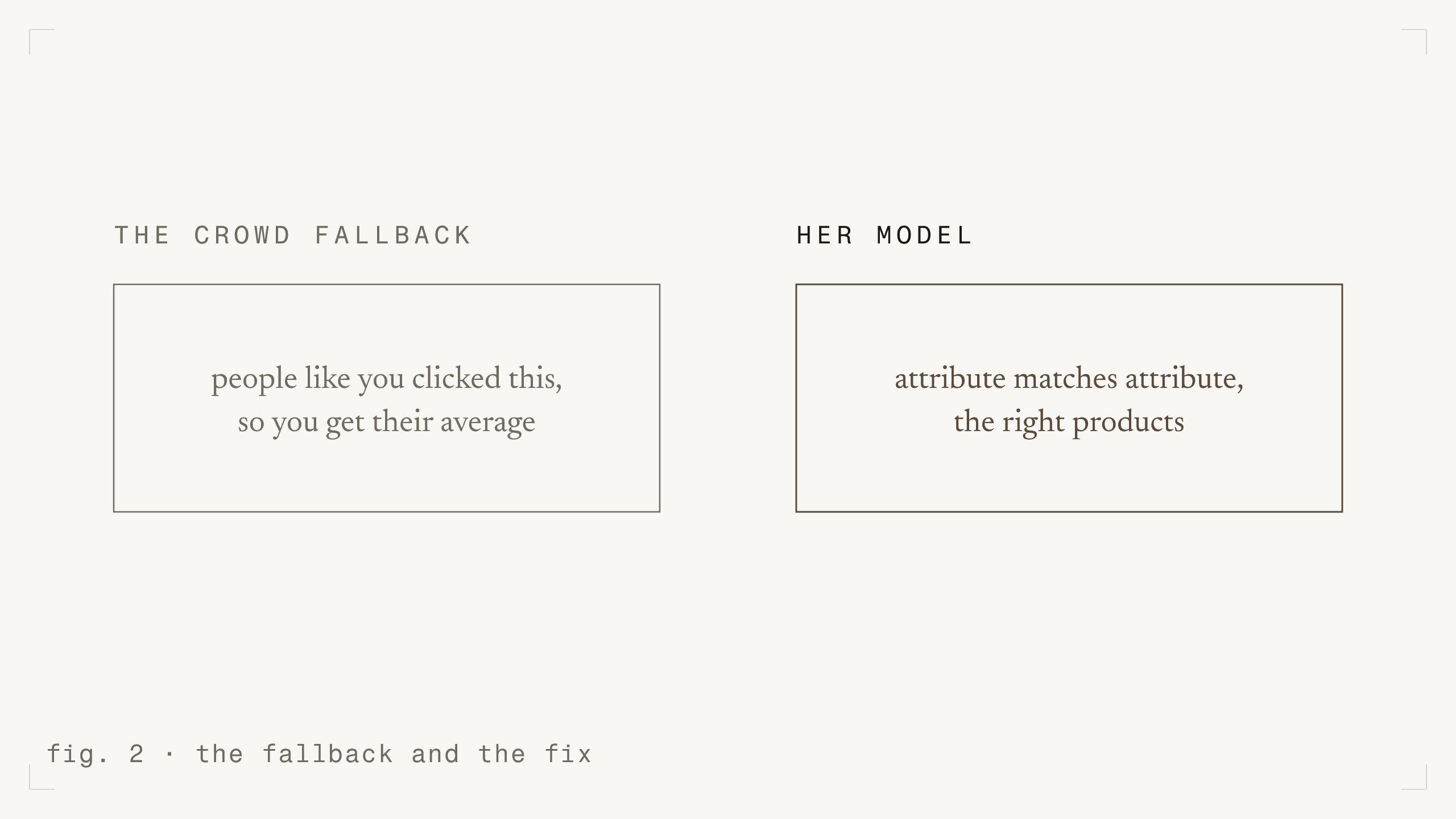
So the system does the only move left to it and reaches for the crowd: people who clicked what you clicked went on to buy this. It’s a fair guess, and it isn’t personalization: it’s the average of people who resemble you. Most of what gets sold as personalization is exactly that.
![fig. 2 - the fallback and the fix [dark]](https://framerusercontent.com/images/WFYQFHXD1C8DbLNq6eEXYF4m4.png)
![fig. 2 - the fallback and the fix [m]](https://framerusercontent.com/images/wVTbEn2bevwCwgXuIqrQRx1xGo.png)
![fig. 2 - the fallback and the fix [m] [dark]](https://framerusercontent.com/images/wTDiuWrYRWJIepHlfnnkOpKF0.png)
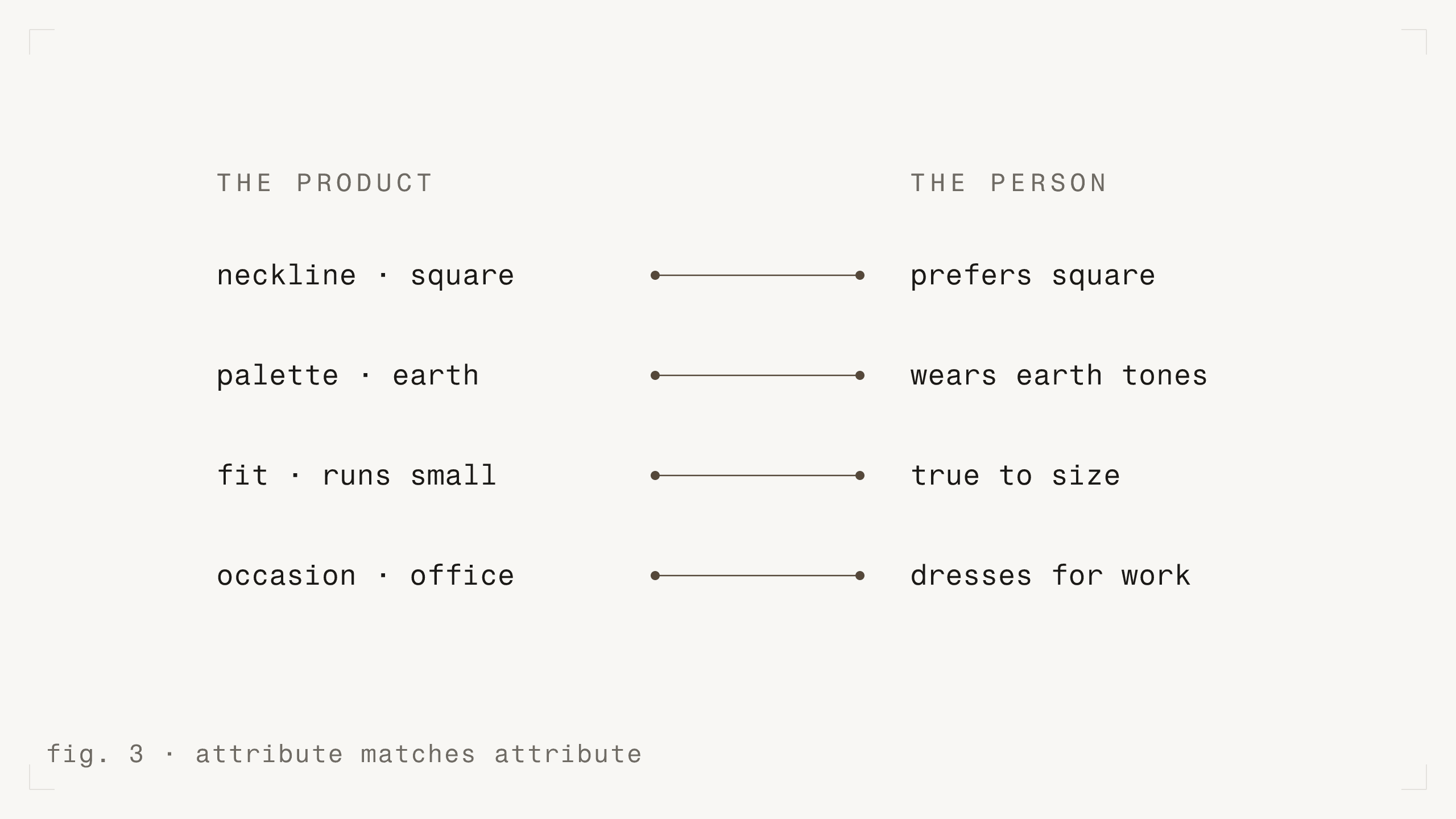
The fix is to finish the job: describe the person the way you describe the product. Not more data about her; the same kind of data. Her taste as a structure: leans minimalist, buys at the top of the price band in one category and the bottom in another, true to size, earth tones, three brands she trusts, mostly dressing for work. Each of those is an attribute, and an attribute matches an attribute. That structure is the customer, written into the same ontology the products are described in. Now the system is reasoning about her in the same terms it uses for the products, instead of sorting her into a segment and guessing from what people who resemble her clicked.
![fig. 3 - attribute matches attribute [dark]](https://framerusercontent.com/images/wEMVYlgkoZ55RkJLN651zN9Bk.png)
![fig. 3 - attribute matches attribute [m]](https://framerusercontent.com/images/yfTY0YTjNC1JDnhHFVu9JTjEwEU.png)
![fig. 3 - attribute matches attribute [m] [dark]](https://framerusercontent.com/images/mwdDxx4pE7F7tCVQc27j399ghM.png)
We did this at Velou for an off-price marketplace that sells name brands at a discount. Each of their shoppers arrives with affinities: certain brands, certain looks. Recommendations only started to land once we modeled those affinities per shopper, in the same attributes the catalog carries. Search conversions went up more than sixty percent.
Why the customer side stays unbuilt is worse than laziness. Thin product data is at least an honest gap: everyone knows the catalog is a pile of keywords; they just don’t want to do the enrichment. The customer side hides. Teams keep saying “we understand our customer” and meaning “we have her clickstream.” The gap is real and denied at the same time, so it stays open.
There’s a rule under this that has held everywhere I’ve worked on it: a connection is only as good as the weaker of the two understandings, and only if both are written in the same terms. Otherwise there’s no connection to grade at all. In a catalog that has had its enrichment done, the weaker side is the customer: the products got structure, and the person is still a log. So the ceiling on personalization, for those systems, is set by the half they never model.
None of this is really about shopping; shopping is just where it’s measurable. Anywhere you connect what a person means to what they should get (a route, a song, a table for tonight, a family’s trip) the person has to be modeled as carefully as the options and in the same language, or the connection is a guess. And the model can’t stop at describing. Each option should carry the actions that go with it: a table can be booked, a meeting can be moved. With the actions attached, understanding the person can end in the right action instead of a better list.
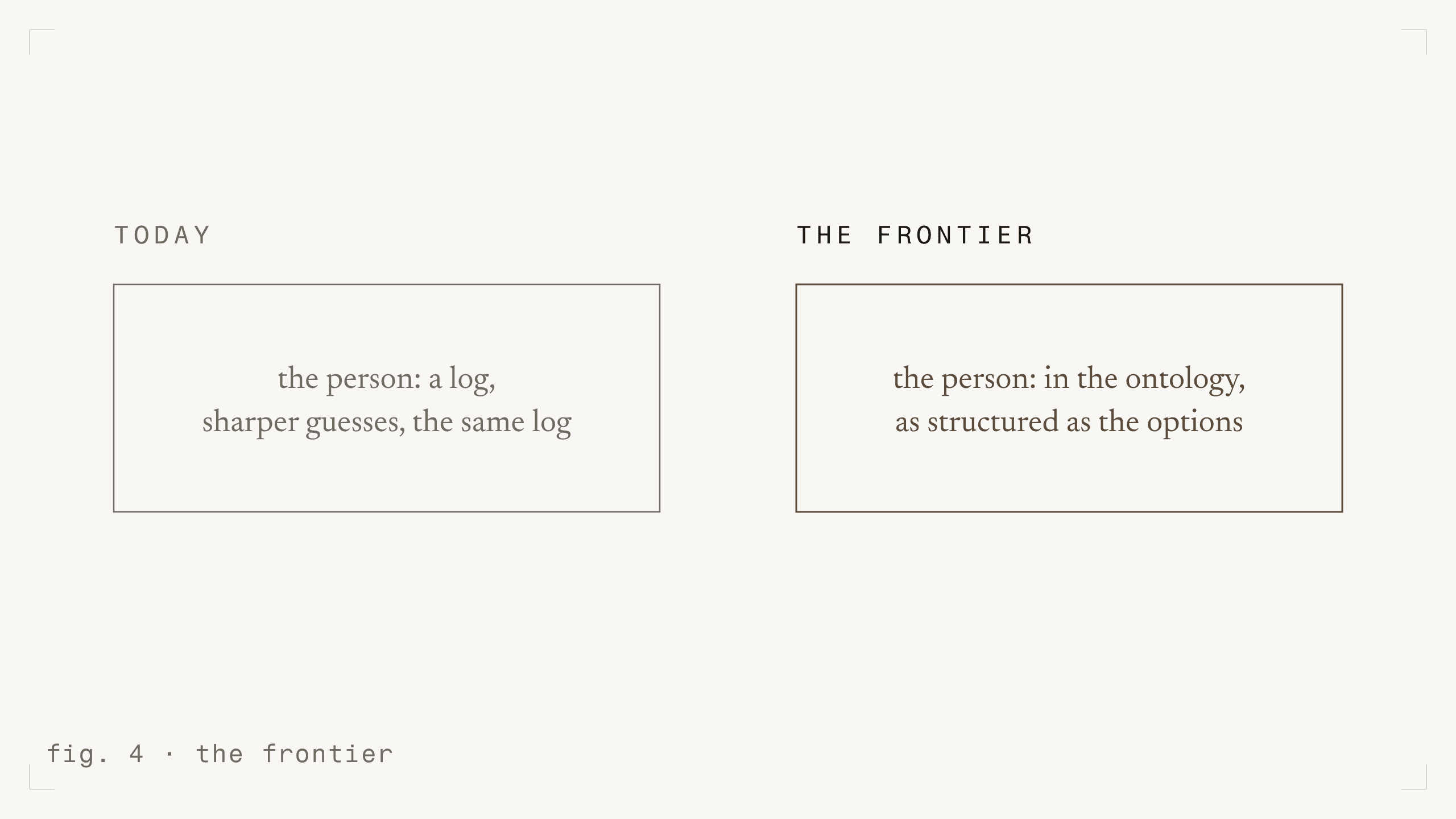
The industry has spent decades reading the person more cleverly, and the result is mostly solved and mostly shallow: sharper guesses, written into the same log. The frontier is the person described in the same ontology as the options, just as deep and just as structured.
![fig. 4 - the frontier [dark]](https://framerusercontent.com/images/k6ctXtkyaoIG3VzSKquKHamYw.png)
![fig. 4 - the frontier [m]](https://framerusercontent.com/images/IZhbhtNyiozDO9Iu9UZratMfqBU.png)
![fig. 4 - the frontier [m] [dark]](https://framerusercontent.com/images/vWf89YkfklE9qIqvyNprnevwPBw.png)
Reading the person only pays off when the person is more than a history of clicks.