A stay in Munich stretched into years when COVID stopped the world, and the way back out was a ranking problem.
I was in Munich because Velou was working closely with the SAP Commerce Cloud team, which is based there. When everything went remote, I stayed. The work with the SAP team kept going, Munich cost far less than the San Francisco I had left, the hours overlapped better with the engineering team, and it had stopped mattering where anyone was. Years later, when my girlfriend Alex, now my wife, and I decided to come back to the US, I did what I do for a living without noticing: I lined up the options, named the objective, and ranked them. The objective was Velou. Where I live has never been the point; the point is where the company’s chances are best. The case for New York was straightforward: most of our customers, ecommerce and retail companies, are headquartered there, our main investor at the time was there, and the East Coast keeps the European customers close. The real alternative was San Francisco, where I had lived for the decade before, with my friends and my network, still the center of the technology world. Austin, Seattle, and Miami surfaced as startup hubs and fell away. We chose New York, and it was the logical choice.
I build ranking systems for a living, and what stayed with me is not the answer we picked. It is everything the decision did not have: no full catalog of the options, no deep descriptions, no way to ever check.
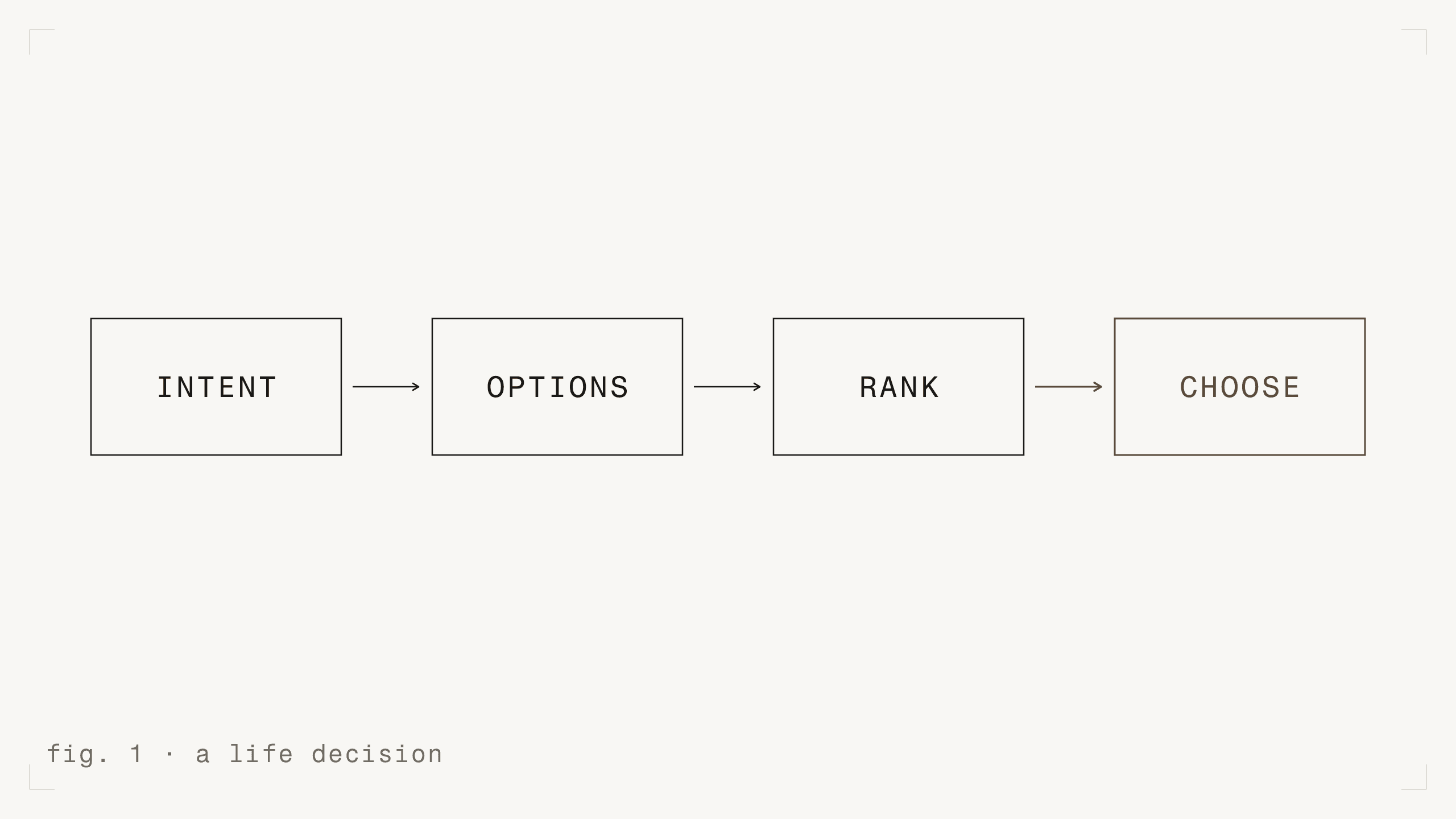
Every decision has that same shape underneath. You have an intent: what you actually want. You have an option space: everything you could pick. You produce a ranking, and you take the top of it. Where to live, who to marry, what to eat tonight: the same problem with different stakes. This is how the machine works, and I can show you every gear. A life runs on the same machine, so it breaks along the same seams: the options, the objective, the eval, the act.
![fig. 1 - a life decision [dark]](https://framerusercontent.com/images/Iv9DuqyQYnnHav5XlKNf8KzL8.png)
![fig. 1 - a life decision [m]](https://framerusercontent.com/images/Vg5e15TXuvA9k3b0Jg8OvFBLE.png)
![fig. 1 - a life decision [m] [dark]](https://framerusercontent.com/images/1Z4jBW7nTcGHifFmdDt2QguGNt8.png)
And because I see the gears every day, I have stopped trusting the machine when it’s pointed at a life. The people I know who are best at ranking, who do it for money, at scale, against real metrics, are the most suspicious of ranking their own decisions. Not out of humility: they have watched, up close, the points where this model stops describing reality and starts lying to you.
The first failure is in the options half, the catalog. A working recommender begins with a known set: every option that exists, stored as rows in a database, ready to be scored. Life refuses to give you that. You will never see the full set. Our move came down to a handful of cities, the ones work and the network made visible, out of every city we could in principle have lived in. Three apartments feels like a search. The system I run scores millions.

![fig. 2 - the catalog you never see [dark]](https://framerusercontent.com/images/xLGRrBpjBVF77PMDJW8rmkHDGJ8.png)
![fig. 2 - the catalog you never see [m]](https://framerusercontent.com/images/YSi0Q8Qziti0zEMPpzJu9jm4I.png)
![fig. 2 - the catalog you never see [m] [dark]](https://framerusercontent.com/images/NGN0NdmbdQ7qb9Fr7cCUaljSxU.png)
And the options you do see, you see thinly. The products I rank are described down to the stitching, every one of them in the same shared ontology; the cities on the shortlist were a few facts each, and my side of the comparison was never written down at all. A ranking is never better than your understanding of what you’re ranking, and it fails on the weaker of the two understandings: what you want, or what there is. My understanding of those cities was a brochure.
That failure at least has a fix: look harder, describe better. The next ones do not.
The second failure is in the person half. The objective is unknown, and it moves. A ranking model is built around a fixed target you have already named: clicks, conversions, watch time. Life rarely gives you one. Even ours, with Velou plainly first, rested on a guess about what the company would need years from now. And the target does not hold still. The target is downstream of the choice. The job you take rewires what you find interesting; the city, once you live in it, changes the person who chose it. In a ranking system the objective sits outside the optimization, fixed, and you push the candidates toward it. In a life the objective is inside, and optimizing toward it deforms it. By the time you arrive, what you were maximizing for is no longer what you want, and you have no way to tell whether you succeeded or whether you simply became someone with different standards.
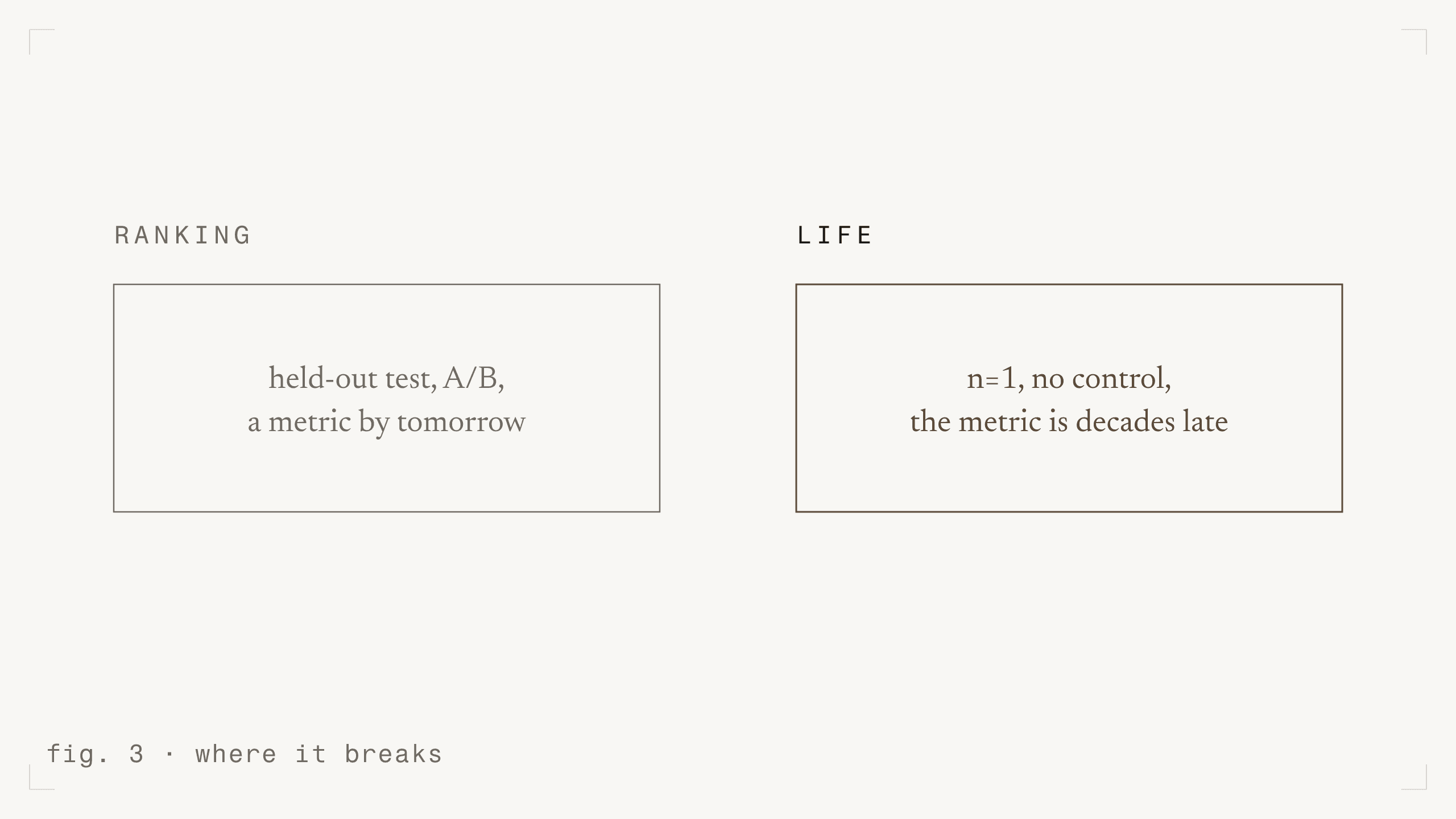
The third failure is in the eval, and it is the one that should frighten anyone who does this professionally. There is no ground truth. Every ranking system I trust is one I can evaluate. I hold out data the model never saw and check whether its ordering matches what actually happened. I backtest against history. I run an A/B test and read the metric back in a week. The trust comes entirely from the evaluation; the score is worthless until something outside the score confirms it. You cannot A/B test moving to New York. There is one run, no control arm, no held-out copy of your life living the other branch so you can compare. I will never know the San Francisco version of my life. The metric, whatever it turns out to be, reveals itself over decades, and by then the inputs are gone and the counterfactual never existed. The hardest ranking problems are not the ones with the biggest catalogs. They are the ones you can never evaluate. Most of the decisions that set the shape of a life are unevaluable, and we make them anyway, because waiting for ground truth means never choosing at all.
![fig. 3 - where it breaks [dark]](https://framerusercontent.com/images/i2RYIyxqmTWSoumgJMQMCtDGmw.png)
![fig. 3 - where it breaks [m]](https://framerusercontent.com/images/daB7r3TGJCl5tPnaUALvYsuAS4.png)
![fig. 3 - where it breaks [m] [dark]](https://framerusercontent.com/images/bpz5ssQNrEiMN9djZgXvJPN8Dw.png)
The fourth failure is in the act itself: the whole instrument is built to maximize, and maximizing is a trap. Ranking has one move: produce the order, take the top. Top-1 is the entire purpose. There is no version of the task where you return the seventh-best result and call it a job well done. But a person who runs his own life that way, always reaching for the single best option, the optimal apartment, the optimal restaurant, the optimal city, pays a price the score never shows. Sheena Iyengar and Barry Schwartz followed job seekers twenty years ago and found the maximizers landed offers worth about twenty percent more, and felt worse about them. The paper is called “Doing Better but Feeling Worse.” The regret comes from the belief itself: that a best option exists, and that they could have found it.
The lesson is not to rank harder. Anyone can write a scoring function. The hard part is knowing where it lies about the world and overriding it by hand. In my own move, the catalog was five cities, the objective was a guess about what Velou would need, and the answer can never be checked. The boundary is the system. The people who sell you methods for optimizing your life will never teach this, because the skill is knowing when the method stops working.

![fig. 4 - the score and the boundary [dark]](https://framerusercontent.com/images/vngXpB3Yu5qYpcyooLe6BzyDKn8.png)
![fig. 4 - the score and the boundary [m]](https://framerusercontent.com/images/GZUSw2F7Y3BHw8ROxHcZhAM90M.png)
![fig. 4 - the score and the boundary [m] [dark]](https://framerusercontent.com/images/LjhoIE76UQOiI4yuRxaEIKMnVGM.png)
This is the machine I work inside all day. The other essays go further in: how it is actually built, end to end, and how a system earns the right to act.